
Year of Publication: 2021
Rating:  ( Must – Read)
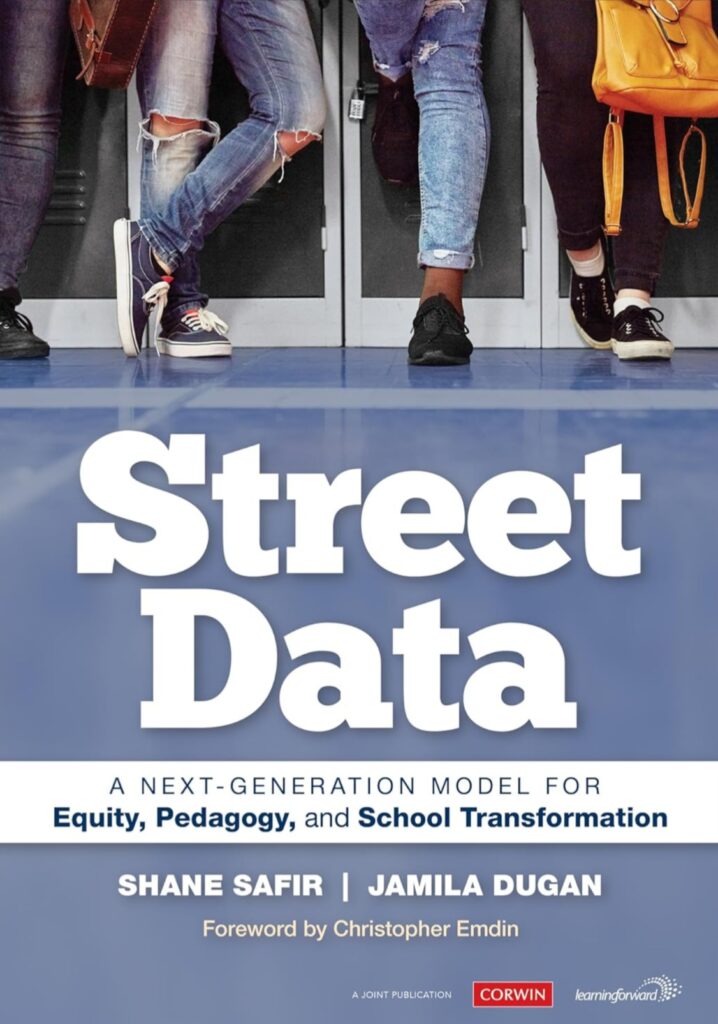
Back of Book Synopsis: Education can be transformed if we eradicate our fixation on big data like standardized test scores as the supreme measure of equity and learning. Instead of focusing on “fixing” and “filling” academic gaps, we must envision and rebuild the system from the student up – with classrooms schools and systems built around students’ brilliance, cultural wealth, and intellectual potential. Street Data reminds us that what is measurable is not the same thing as what is valuable and that data can be humanizing, liberating, and healing.
Our Favorite Quote(s):
- Current testing practices continue to dehumanize young people and teachers while leading us further and further from educational equity…The end ( increasing test scores and closing an achievement gap, which we will argue in this book is a racialized fiction) no longer justifies the means of packet-driven, teacher-centered pedagogy that pre-existed but was roundly reinforced by the No Child Left Behind Era… Our usual beacons of success- test scores, grades, seat time- have evaporated like water off a turbulent pot. While many clamor for a “return to normal”, the voices of educators across the globe are converging around a demand for a new normal: What would it look like to let go of all of our assumptions and rebuild the system from the bottom up, from ,the stud,ent up? (p.2)
- Street data- real-time, on the ground, systematic information- is our guiding light as we work toward equity. It is going to take a radical shift in our data paradigm to propel the kind of instructional transformation we need: deep, equitable, culturally sustaining learning. (p.29)
- The idea of throwing yourself into a change process with no known outcome and just a line of inquiry may feel uncomfortable and revolutionary all at once- a blast of fresh air on the stale econometric framework, which assumes we can datafy and plan our way to new results. By contrast, emergence requires for us to slow down, listen deeply to those at the margins, bring folks to the table to reimagine the landscape with us, and move in partnership to build a new reality…Collaboration and reflection are embedded in every step of the journey. No one ever reached an equity or social transformation goal alone. We need a village. We belong to a village, with children at the center. Who is your village with whom you will build the courage and vision to do this work? (p.79)
What Have Others Said?: Street Data calls upon readers to “flip the dashboard” from a focus on big data to a focus on the voices at the margins – those learners and their families who have been most affected by deep-rooted systemic inequities. When we listen closely to these voices with curiosity, courage, and humility, we gain a greater understanding of the meaning and root causes of these inequities, as well as how they can be addressed in ways that transform and heal. Policy makers and educators at every level of the system need this book to forge a path to genuine equity.
– Linda Darling-Hammond, Professor Emeritus at Stanford University and President of the Learning Policy Institute.
Noteworthy Appendix Documents:
- AwAward-winningublic elementary school example of a profile of the students who will be promoted from their schoolhouse (6.1)
- Student-authored descriptors of the art of social justice teaching (6.2)
- Empathy interview transcript with a middle school student, teacher think-aloud included (8.1)
- Process guide to instructional rounds (8.2)
Questions Raised for Us:
- How do we dig up the roots of our deepest beliefs about education that have never served students at the margins?
- What is a clear definition of equity-high learning for all?
- How does our quest for urgency get in the way of understanding complexity and the need for complex analysis?
- What are dethe fault didiscoursesnd behaviors that are in the way of the work?
- Are we using the right data to make the most important decisions, or are we using data to further marginalize the students we claim to serve?
- How do we uncover student assets?
- How do we cultivate the unique gifts, talents, and interests that every person possesses?